Engineering solutions
Dry ice production equipment, turnkey
A pelletizer is only as stable as the liquid CO₂ that feeds it. We design the part of the workshop that decides whether it runs every shift: the tank, pressure building, piping to the machine and the raw material supply behind it.
What a dry ice workshop consists of
| Unit | Why it matters | What we size |
|---|---|---|
| Cryogenic liquid CO₂ tank | raw material reserve between deliveries | 30–50 m³ depending on output |
| Pressure building coil | holds 18–21 bar at the pelletizer inlet | for continuous, not average, draw-off |
| Insulated liquid line | liquid does not flash on the way to the machine | shortest run the layout allows |
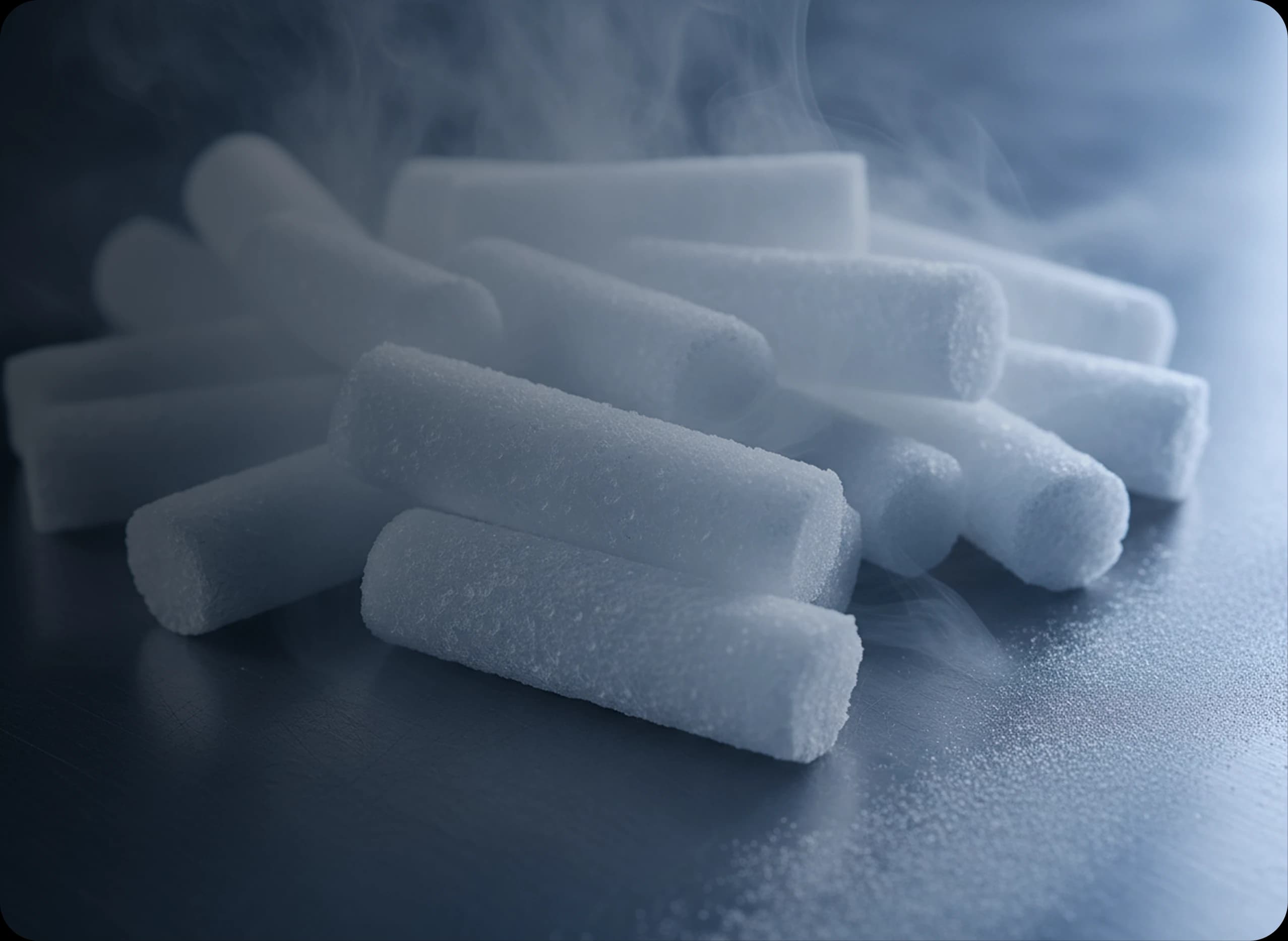
| Pelletizer or block press | 3, 16, 19 mm pellets or blocks | for your market and shift pattern |
| Flash gas vent line | 55–60% of the flow leaves as gas | routed outdoors, away from air intakes |
| Gas detection and ventilation | CO₂ collects at floor level | alarms at 0.5% and 1.5% |
How much liquid CO₂ it takes
In pelletizing only 40–45% of the liquid becomes ice; the rest flashes off and carries away the heat needed to freeze it. Without returning that gas to liquefaction the norm is 2.2–2.5 kg of liquid CO₂ per kilogram of pellets.
| Pellet output | Liquid CO₂ | Per 8-hour shift | Per month, 22 shifts |
|---|---|---|---|
| 100 kg/h | 230 kg/h | 1.8 t | 40 t |
| 200 kg/h | 460 kg/h | 3.7 t | 81 t |
| 300 kg/h | 690 kg/h | 5.5 t | 121 t |
| 400 kg/h | 920 kg/h | 7.4 t | 162 t |
This is the workshop's main constraint: the tank is sized to the raw material delivery schedule, not to the catalogue. For a 200 kg/h line running full shifts, a 50 m³ tank is less than two weeks of supply.
How we put the solution together
- Output and market: how much product, which pellet size, and whether demand is seasonal.
- Raw material: liquid CO₂ demand, grade (food market means food grade to ISBT), minimum delivery and distance to the filling plant.
- Tank and pressure: volume for one full road tanker plus a working reserve, pressure building for continuous draw-off.
- Layout: positions of the tank, pelletizer and product store, liquid lines and gas venting.
- Installation, commissioning and staff training; pressure vessel documentation.
The norms and start-up pitfalls are covered in How much liquid CO₂ a tonne of dry ice takes. A working Ukrainian example is IceLab: Kyiv and Lviv, up to 400 kg/h, a 60-tonne raw material store.
Frequently asked questions
Can a pelletizer run from CO₂ cylinders?
Only a small laboratory unit. A production pelletizer draws hundreds of kilograms of liquid an hour: a 100 kg/h line empties a 40 l cylinder in about six minutes. Production needs a stationary tank with pressure building.
Why do pellets come out soft and sublimate quickly?
Most often the inlet pressure has dropped below the pelletizer's band. Continuous heavy draw-off cools the tank and pressure falls; without a pressure building coil sized for that flow the machine presses low-density pellets.
Does dry ice for food have to be made from food-grade CO₂?
Yes. Pelletizing purifies nothing — whatever is in the liquid ends up in the pellet and sublimates onto the product. For food, catering and pharmaceuticals the raw material has to be food grade to ISBT.
Equipment for this solution
- Cryogenic tanks for liquid CO₂ (carbon dioxide) 10–100 m³Supply of stationary vacuum-insulated cryogenic tanks for liquid CO₂ storage with volumes of 10, 20, 30, 50, 80 and 100 m³. Complete with shut-off and safety valves, pressure control systems, vaporizers and pressure-reducing units. Equipment selection, supply, installation, process piping and turnkey commissioning of the CO₂ system.
- Laboratory and analytical equipment for CO₂ quality control (DSTU, ISBT, EIGA)Supply of equipment for laboratory quality control of carbon dioxide (CO₂): CO₂ purity, dew point, moisture content and other controlled impurities. Laboratory setups for CO₂ producers, food plants and beverage manufacturers.
- Turnkey installation of cryogenic and gas supply systemsWe install cryogenic tanks, vaporizers, gasifiers, pipelines, reducers, pressure regulators and shut-off and safety valves for CO₂, N₂, O₂ and Ar. The scope covers equipment selection and supply, installation on prepared foundations, process piping, connection and start-up of the gas supply system.